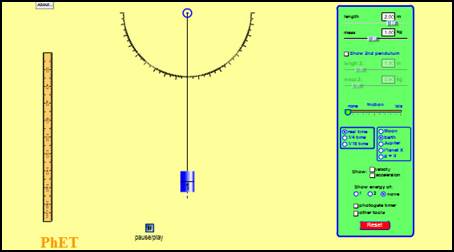
PENDULUM LAB
Unit Overview
In this activity you will
investigate how variables affect the motion of a pendulum. You will discover how the period of a simple
pendulum depends on the length of the string and the mass of the pendulum bob.
It's easy to measure the period using the photogate timer provided with the
simulation.
Background Information
A simple pendulum has a
mass (m) “bob” hanging from a string of length (l) fixed at a pivot point. When
displaced to a small initial angle and released, the mass will swing back and
forth in periodic motion. The period is the time it takes to complete one whole
swing.
One day in the late 1500s, a man named Galileo Galilei
was sitting in church when he noticed the lamps hanging from the ceiling were
swinging back and forth. Some of the lamps were making great big swings, and
others were only making little swings back and forth, but they all went back
and forth pretty regularly. Galileo was a curious man, and so he decided to use
his heartbeat to measure how long it took the pendulums to swing back and
forth. He was very surprised by what he learned. Today, you will repeat
Galileo's experiment to learn about pendulums.
Before beginning the simulation scroll to
the question section below and answer the Pre-Lab Questions 1-8.
Part I: Mass and Number of Swings
Part II: Length and Number of Swings
Part III: Gravity and Number of Swings
Pendulum Lab: http://phet.colorado.edu/en/simulation/pendulum-lab
You
can download the lab to your desktop. It is wise to house all of the
simulations in a folder so you can refer back to them when needed.
Download the printable
worksheet below, you will use this to record all of your lab information. You
will attach your worksheet to question #6 in the question section.
A Look Ahead
In the next unit we will learn
about sound. Sound is a vibration carried by waves. There are many properties
of sound that we will explore including the Doppler effect, resonance,
interference, reflection and refraction. Both sound and light waves have some
of these similar properties and we will explore light waves in later units.

Below are additional educational resources and activities for this unit.